
Emergency Air Duct Cleaning Near Me: What Westminster Homeowners Should Do First
If raw sewage or floodwater has entered your ductwork and you run the HVAC system before isolating it, you’ve just aerosolized contaminated particulates through every room in your house – the cleaning job just became a remediation job. That single mistake is the difference between a straightforward duct cleaning and a full-blown restoration project. We wrote this as a first-responder protocol, not a sales pitch, so you can act in the right order when something genuinely serious happens in your Westminster home.
What Actually Counts as a Duct Emergency in Westminster?
If you’re searching for emergency air duct cleaning in Westminster CO, the first thing to sort out is whether you have an actual emergency on your hands. Most frantic calls we take are urgent but not emergencies, and treating a routine problem like a crisis usually leads to a rushed job that costs more than it should. Three scenarios are true emergencies because contamination is actively spreading or your health is at risk. The rest can wait for a scheduled appointment and a proper inspection.
The three real emergencies
- Biological contamination entering the system. Sewage backup, floodwater, or a dead animal in a return plenum. Anything wet and organic that reaches your ductwork feeds mold and bacteria, and circulating air spreads it through the house.
- Fire or smoke residue. Even a small kitchen fire pushes soot and combustion byproducts into the return side. The residue is acidic and it smells, and it doesn’t disappear on its own.
- Confirmed mold with active circulation. If you can see mold growth inside a register or on the plenum and the system is still running, you’re blowing spores into every room every time the fan kicks on.
What’s urgent but not an emergency
Rodent droppings in a duct, a musty smell you can’t place, uneven airflow to one side of the house, or a jump in your energy bill. These deserve prompt attention and a proper inspection, but you don’t need to panic-seal the house. In our experience around Westminster, most of these trace back to a disconnected joint or a dirty system that’s been neglected for years – fixable on a normal schedule with professional equipment.
The Containment Checklist: What to Do Before Any Crew Arrives
Before anyone shows up, your job is to stop the spread. Think of it as triage: isolate the system, protect the living space, and document everything. This sequence applies whether the problem is sewage, smoke, or mold, and doing it well makes the actual cleaning faster and more complete.
- Shut the HVAC system down at the breaker. Not just the thermostat – the breaker. That stops the fan from pulling contaminated air through the whole house. Leave it off until a technician tells you otherwise.
- Seal the registers with plastic sheeting and tape. Cover supply and return grilles in the affected rooms so nothing back-drafts into your living space.
- Document with photos. Photograph visible contamination, water lines, and any damage before you move anything. Your insurer will want this, and it helps the crew plan containment.
- Keep people and pets out of the affected rooms. Especially anyone with asthma or allergies. Don’t run fans or a portable air purifier near the sealed registers.
- Call and describe exactly what happened. “Water came in” and “sewage backed up into a floor return” are very different jobs, and the dispatcher needs the details to send the right equipment.
If you’d rather not handle any of this yourself, call (855) 337-2019. We answer 24/7, with fast dispatch from 7am to 7pm, Sunday through Friday, and we’re closed Saturday.
How a Remediation-Grade Cleaning Differs From a Standard Cleaning
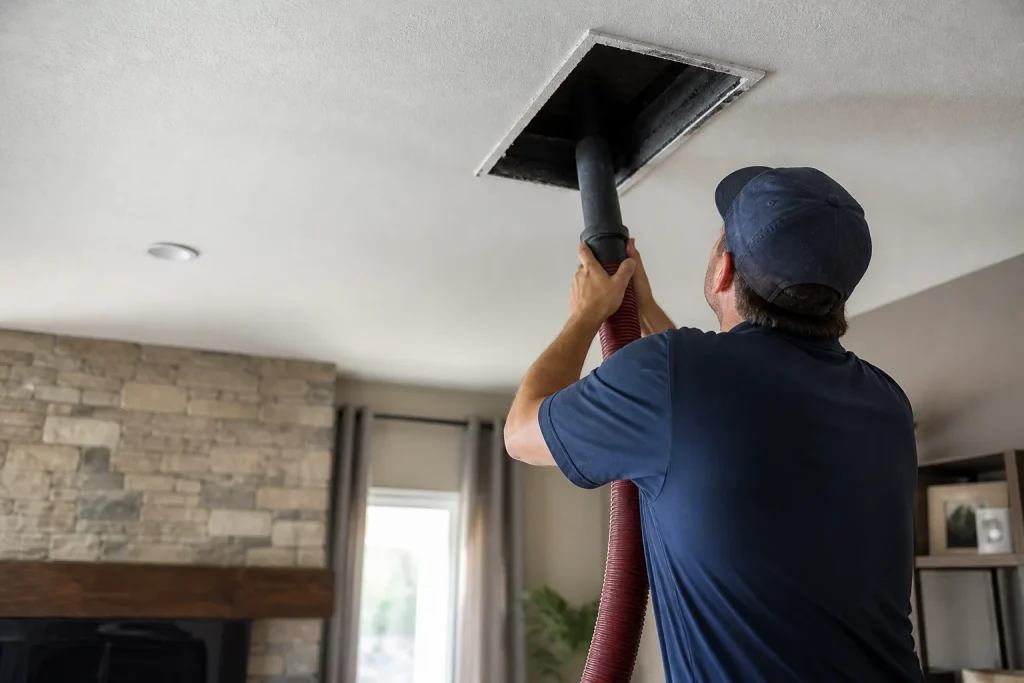
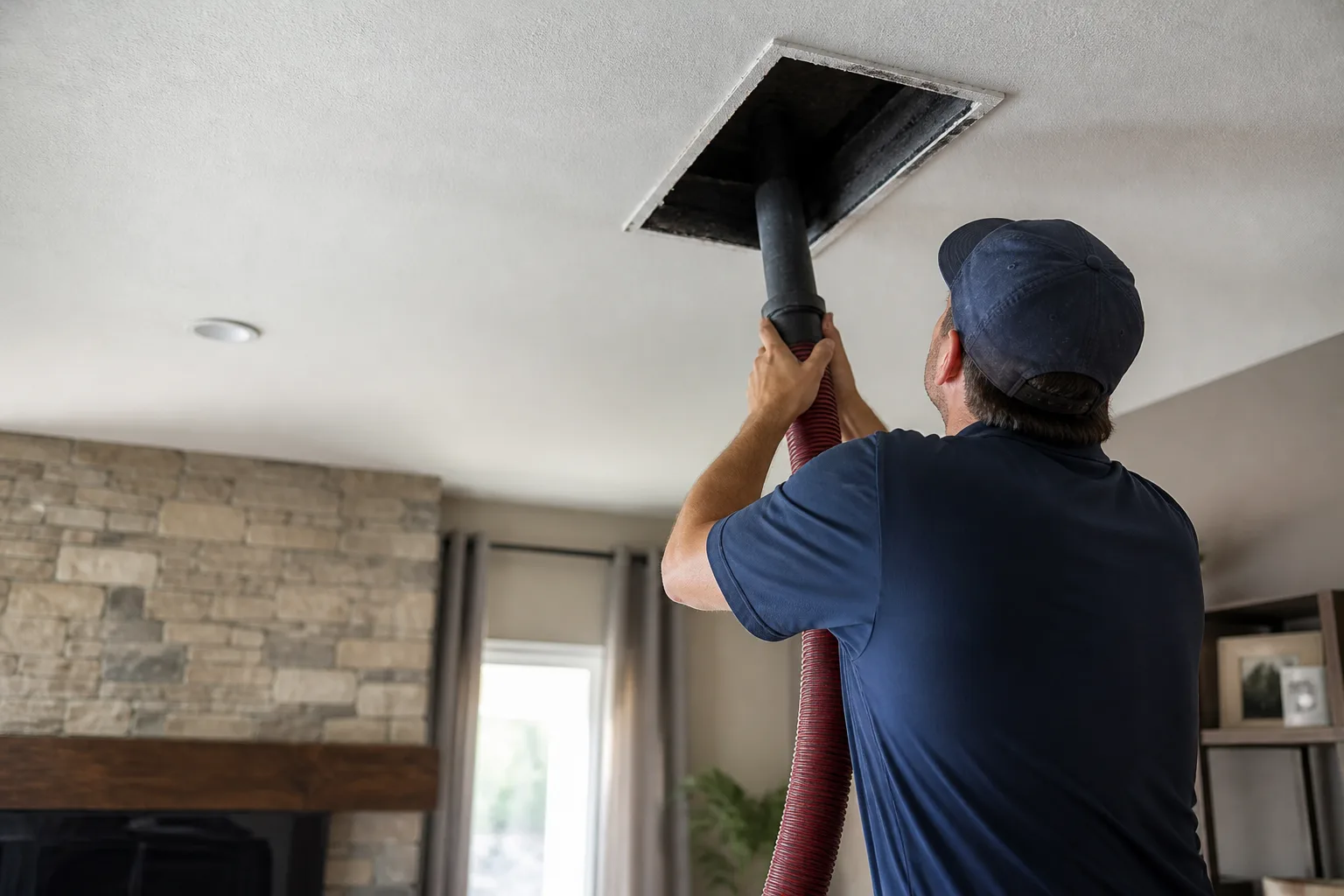
The gap between a standard duct cleaning and true remediation is equipment and process, not effort. A standard cleaning pulls loose debris out of the system. A remediation-grade job first contains the contamination so it can’t spread, then removes it, then verifies the air is clean. If a company shows up with a shop vacuum and no containment, they’re not equipped for a biological, smoke, or mold emergency.
Here’s what proper remediation involves:
- HEPA negative-air containment. We deploy Abatement Technologies air scrubbers and negative-air machines to keep contaminated air from migrating into clean rooms during the work. This is the step that most competitors skip entirely, and skipping it means the contamination just moves around.
- Mechanical cleaning with professional tools. Rotobrush rotary-brush systems and Nikro HEPA-rated vacuums are the industry benchmark for thorough duct cleaning – not consumer blowers or shop vacs.
- EPA-registered biocide application. Where biological contamination is present, sanitizing with Guardsman antimicrobial products targets what brushing alone can’t reach.
- Post-cleaning air quality verification. A proper job ends with a check that the problem is actually gone, not just that the ducts look cleaner.
For a routine cleaning, see our air duct cleaning service. When contamination is involved, the process above is what you want to ask about specifically.
Westminster Basement Floods and Floor-Level Return Boots
Westminster sits where spring snowmelt runs hard, and basements here are prone to taking on water. When a basement floods, water often channels straight into the floor-level return boots – the low openings at the base of the wall that feed the return side of your system. That’s the scenario that turns a wet basement into a duct emergency, because the water wicks into the duct lining and insulation where it sits damp and feeds mold.
Here’s how to identify whether it happened to you:
- Check the floor-level return covers right after any flooding or heavy snowmelt. If there’s moisture or staining at the base, water reached the boot.
- Look for a musty smell that shows up only when the heat or AC runs.
- Notice water lines on the basement floor that run toward a return opening.
When you call, tell the dispatcher that spring snowmelt or a flood reached a floor-level return boot. That detail changes the job – the crew knows to inspect the boot and the run behind it, not just the visible grille. Duct problems in Westminster basements are often about water first and debris second.
Questions to Ask Before You Book Any “Emergency” Duct Service
Anyone can answer a phone at 2am and call themselves an emergency service. The real question is whether they have the equipment to do remediation-grade work, or whether they’ll show up with the same van they use for routine cleanings. Ask these questions before you commit.
- “What containment equipment do you bring?” If they can’t name negative-air machines or HEPA air scrubbers, they can’t contain contamination. Abatement Technologies scrubbers are a good sign they know what they’re doing.
- “Do you use rotary-brush and HEPA vacuum systems?” Rotobrush and Nikro equipment signals a professional setup rather than a shop-vac operation.
- “Do you offer sanitizing after cleaning?” For biological or mold issues, cleaning alone isn’t enough. Guardsman antimicrobial products address what mechanical cleaning leaves behind.
- “Can you verify air quality after the job?” Remediation should end with a check that the contamination is gone.
- “Will you repair what you find?” If a return boot is disconnected or a joint is failing, sealing it is part of fixing the problem. Our HVAC cleaning and duct repair work usually go together.
Whatever the problem is, the aim is a single crew that can clean, repair, seal, and sanitize start to finish rather than hand you off to another contractor mid-job. That’s the difference between a cleaning that fixes the symptom and one that fixes the cause. For related work like removing lint buildup that can become a fire risk, our dryer vent cleaning follows the same containment-first approach.
The Bottom Line
A duct emergency is really about contamination spreading, and the right first move is always to stop the spread before anything is cleaned. Shut the system down at the breaker, seal the registers, document the damage, and tell the dispatcher exactly what got into the ducts. Skip those steps and even a good cleaning crew has to start over – or the job turns into a full remediation. When you do call, ask about containment equipment and post-cleaning verification, because that’s what separates real remediation from a standard cleaning dressed up as an emergency.
Our technicians have up to 15 years of experience with the equipment that matters: Rotobrush rotary-brush systems, Nikro HEPA vacuums, and Abatement Technologies containment. We repair what we find, and we finish with an air quality and sanitizing step using Guardsman products so you can breathe the difference. If you’re in Westminster and need help, Air Duct Cleaning Westminster Pros offers free estimates – call (855) 337-2019. We answer 24/7. Fast dispatch from 7am to 7pm, Sunday through Friday, and we’re closed Saturday.
Frequently Asked Questions
Act the same day. Shut the HVAC system down at the breaker immediately and seal the affected registers, because every hour the fan runs spreads contamination further. Call us and describe whether it was sewage, floodwater, or spring snowmelt. Call (855) 337-2019 for an exact quote – estimates are free.
No. A standard cleaning removes debris but doesn’t contain contamination or address what’s left behind. Mold and smoke emergencies need HEPA negative-air containment, rotobrush mechanical cleaning, and a sanitizing step with EPA-registered products, followed by air quality verification. Ask any company whether they use Abatement Technologies scrubbers before you book. Call (855) 337-2019 and we’ll walk you through what your situation needs.
Because floor-level return boots sit low on the wall, and water running across a basement floor channels straight into them. It’s one of the most common ways ductwork here gets wet during spring snowmelt. If a return boot took on water, tell the dispatcher so the crew inspects the boot and the duct run behind it – not just the visible grille. Call (855) 337-2019 for a free estimate.
A true emergency involves active contamination spreading – sewage or floodwater in the ducts, fire residue, or confirmed mold with the system running. Musty smells, uneven airflow, and rodent evidence are urgent but can wait for a scheduled visit with proper inspection. If you’re unsure which you have, call (855) 337-2019 and describe what you’re seeing. Estimates are free.
Written by the team at Air Duct Cleaning Westminster Pros.
Need Air Duct Cleaning Help?
Call Air Duct Cleaning Westminster Pros - the local pro we connect you with is licensed and insured, with free written estimates in Westminster.
(855) 337-2019